


How to Read a Constellation Poster: Star Charts, Celestial Coordinates & Room Styling (2026)

A constellation poster is a two-dimensional map that projects the three-dimensional night sky onto flat paper using spherical coordinate systems. To read one accurately, you identify the celestial poles, trace right ascension hour lines and declination degrees, and understand that dot sizes represent star brightness rather than physical star dimensions.
Most people hang a star map because the dark ink and fine white linework look calming in a bedroom or above a desk. Yet standing six inches away, looking at a maze of concentric circles, Latin names, and tiny numbered ticks, it is easy to wonder whether the print represents genuine celestial mechanics or just decorative fiction.
Whether you bought a vintage planisphere chart, received an astronomy star map as a gift, or are styling a celestial corner in your apartment, this guide breaks down how to decode every symbol on your wall and display it properly without lighting glare or cramped wall spacing.
Anatomy of a Star Chart: What the Lines, Dots, and Grids Mean on a Constellation Poster
A celestial map looks complex at first glance because it combines spherical geometry, historical cartography, and observational astronomy on a single surface. Once you break the print down into its four basic graphic layers, the entire layout makes sense.
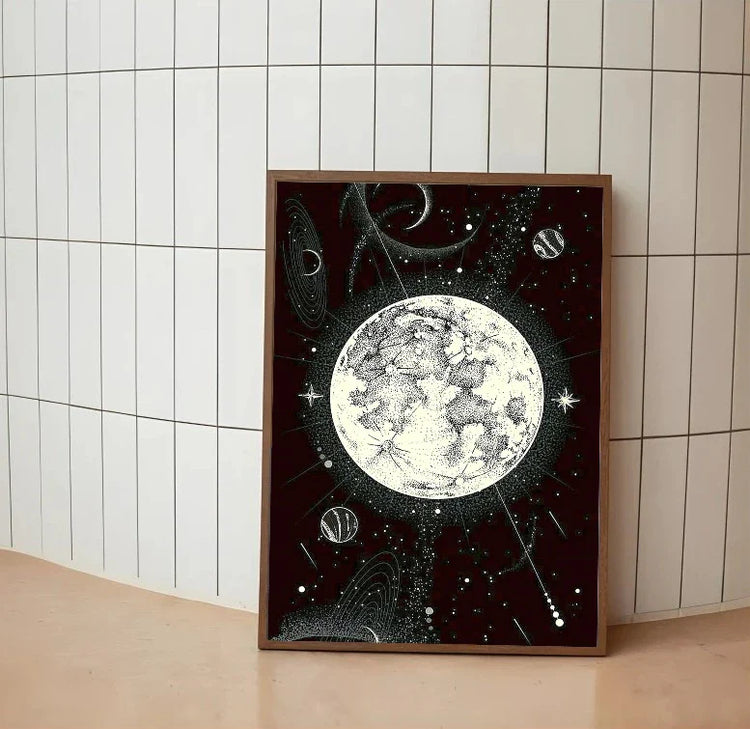
1. Connecting Stick Figures vs. Formal Constellation Boundaries
The lines connecting stars into recognizable figures like Orion or Ursa Major are known as stick figures or asterisms. They are visual memory aids developed across cultures to trace animals, mythic heroes, and tools across the sky.
In formal astronomy, a constellation represents an officially bounded sector of the sky rather than merely the connecting lines. In 1930, Belgian astronomer Eugène Delporte drew official borders for the 88 official constellations recognized by the International Astronomical Union (IAU). On detailed charts, these boundaries appear as faint dashed or dotted polygons dividing the sky like international borders on a world globe.
When looking at your print, notice whether it shows only the popular stick lines or the full boundary polygons. Prints in Art Theory's Through The Telescope celestial collection often preserve both the classic illustrative connections and the geometrical boundary framing for authentic visual balance.
2. Dot Size Represents Apparent Magnitude, Not Physical Size
A common misconception is that a bigger dot on a star chart means a larger star in physical volume. In reality, dot diameter indicates apparent magnitude, which measures how bright a star appears to an observer on Earth.
The magnitude system dates back over 2,000 years to Greek astronomer Hipparchus, who classified stars visible to the naked eye into six brightness tiers: - 1st Magnitude (Largest dots): The brightest beacons like Sirius, Vega, Canopus, and Betelgeuse. - 2nd to 3rd Magnitude (Medium dots): The stars that form primary constellation outlines, such as the seven stars of the Big Dipper (Saptarishi). - 4th to 6th Magnitude (Smallest specks): Fainter stars barely visible from suburban balconies with moderate light pollution.
Every authentic cosmic star chart includes a small legend in the bottom margin showing a series of graduating circles labelled from magnitude 1 down to magnitude 6.
Celestial Coordinates: Right Ascension and Declination Made Simple
If you want to orient your wall art to the sky outside your window, you need to read the grid lines running across the circle. Earth's cartographers use latitude and longitude to locate cities; astronomers project those same lines outward into space as declination and right ascension.
Right Ascension (The Sky's Longitude)
Right Ascension (RA) lines radiate from the center of circular planispheres like spokes on a bicycle wheel, or run vertically on rectangular cylindrical charts.
Instead of degrees, Right Ascension is traditionally measured in hours, minutes, and seconds (0h to 24h). Earth rotates 360 degrees in approximately 24 hours, meaning each single hour of Right Ascension equals exactly 15 degrees of sky rotation. The starting point (0h 0m 0s) is marked by the Vernal Equinox point in Pisces, where the Sun crosses the celestial equator going north each March.
Declination (The Sky's Latitude)
Declination (Dec) measures how far north or south an object sits relative to Earth's equator: - 0° Declination: The Celestial Equator, directly above Earth's real equator. - +90° Declination: The North Celestial Pole, located right next to Polaris (the North Star). - -90° Declination: The South Celestial Pole, near the Southern Cross (Trishanku).
If you live anywhere in India (between roughly 8°N in Kanyakumari and 32°N in Punjab), stars with declination between +80° and -50° will pass across your sky at different months throughout the year.
The Ecliptic: The Sun's Annual Highway
Look closely for a curved or dashed line that intersects the celestial equator at two opposite points. This is the Ecliptic. It marks the geometric plane of Earth's orbit around the Sun.
Because our solar system is relatively flat, the Moon and all major planets (Mars, Jupiter, Saturn, Venus) always stay within a narrow band of 8 degrees on either side of the ecliptic line. This band passes through the 12 classic zodiac constellations plus Ophiuchus.
Quick Symbol Reference for Star Charts
| Element on Chart | What It Means in Astronomy | How It Appears on Quality Prints |
|---|---|---|
| Graduated Dot Circles | Apparent stellar magnitude (brightness) | Defined scale in legend (mag 1 through 6) |
| Radial Spoke Lines | Right Ascension (0h to 24h) | Numbered tick marks around the circular outer bezel |
| Concentric Ring Lines | Declination (+90° at center to 0° or negative at edge) | Concentric circles stepping in 10° or 15° increments |
| Curved Sinusoidal Path | The Ecliptic line | Sinuous track crossing zodiac constellations |
| Stippled Shaded Bands | Galactic Plane / Milky Way | Soft textural cloud pattern traversing Cassiopeia and Cygnus |
| Greek Letter Prefix | Bayer Designation (α, β, γ) | Identifies relative brightness rank within that constellation |
Decorative Art vs. Scientific Sky Maps: How to Tell What You Have
Not all celestial wall prints serve the same purpose. Understanding the distinction between an astronomical sky chart, an antique engraver's illustration, and a modern graphic poster helps you set the right expectations for your room.

1. Planispheres and Hemispheric Projections
A true planisphere is a circular star map designed for a specific hemisphere. - Northern Hemisphere Maps: Feature Polaris at the direct geometric center. The perimeter shows stars down to the equator or slightly into the southern sky. - Southern Hemisphere Maps: Feature the Octans constellation at the center, highlighting Centaurus, Crux, and the Magellanic Clouds.
If your poster depicts both hemispheres side by side inside twin circular frames, you are looking at a classic double-hemisphere stereographic projection, popularized during the 17th and 18th centuries by Dutch and French cartographers like Frederik de Wit and Johann Doppelmayr.
2. The Astronomical Epoch (Why Dates Matter)
Because of a slow wobble in Earth's rotational axis called axial precession, the orientation of stars relative to our coordinate grid shifts by about 1 degree every 72 years.
Scientific star charts always declare an Epoch in their corner notes: - Historic prints often specify Epoch 1850 or Epoch 1900. - Modern astronomical charts use Epoch J2000.0 (referenced to January 1, 2000).
If a vintage chart displays slight coordinate offsets compared to a mobile astronomy app on your phone, the map is not incorrect. It simply preserves the historical coordinates of the era in which the copperplate was originally engraved.
3. Figurative Engravings vs. Minimal Technical Line Art
Some prints reproduce historic plates from Johann Bayer’s 1603 Uranometria or Johannes Hevelius’s 1690 Prodromus Astronomiae, where stars are plotted directly onto lushly illustrated figures of mythical beasts, hunters, and queens.
Modern minimalist astronomy posters, on the other hand, strip away the mythological drawings entirely, leaving only high-contrast vector lines, coordinate circles, and crisp typography. Both styles have strong decor merits: figurative vintage maps add rich academic character to study spaces, while minimalist technical plots suit clean, contemporary bedrooms.
Choosing Print Size and Paper Quality: Why Legibility Depends on Scale
When choosing a constellation poster for your room, size is not merely an aesthetic choice. It directly determines whether the tiny catalog labels and fine coordinate grids remain readable or blur into illegible visual noise.
The A6 and Postcard Sizing Mistake
In standard collage kits, many prints are produced at A6 size (10.5 × 14.8 cm / roughly 4 × 6 inches). While A6 works wonderfully for bold lifestyle photos, typography quotes, or minimalist botanical leaves, it is simply too small for a detailed celestial star map.
At A6, a comprehensive chart packing thousands of individual stars, Greek Bayer letters, and coordinate numbers forces typography down to 3 or 4 points. The ink bleeds across tiny star clusters, making Orion look like an ink smudge and rendering right ascension ticks unreadable.
The Sweet Spot: A4 and A3 Dimensions
For personal rooms, study desks, and gallery walls, two sizes provide the ideal balance between detail and wall space:
- A4 (21.0 × 29.7 cm / 8.3 × 11.7 inches): Suitable for clean, minimalist constellation prints focusing on one specific constellation (such as Orion, Cassiopeia, or your zodiac sign) or smaller seasonal sky charts viewed from arm's length at a desk.
- A3 (29.7 × 42.0 cm / 11.7 × 16.5 inches): The standard recommendation for full-hemisphere star charts and detailed vintage celestial cartography. At A3, fine degree ticks, constellation borders, and magnitude legends can be read clearly from a natural standing distance of 1.5 to 2 feet.
For broader spacing guidance and calculating total wall coverage across multiple frames, review our in-depth poster size guide for Indian rooms.
Paper Weight and Finish: The Battle Against Glare
Most celestial wall art relies on rich, deep backgrounds: midnight indigo, deep charcoal, or obsidian black. This makes surface finish critically important.
Cheap commercial prints produced on thin, glossy 130–150 GSM paper turn deep black backgrounds into mirrors. Light from a bedside table lamp, overhead ceiling tube, or nearby window bounces straight into your eyes, completely washing out the delicate white star points.
Art Theory prints all single posters on 350 GSM premium matte cardstock paper. The heavyweight substrate ensures the poster hangs flat without edge curls, while the soft matte texture absorbs ambient room light, keeping the white constellation lines sharp and readable from any angle in the room.
4 Practical Rules for Styling Constellation Wall Art in Modern Rooms
Integrating space posters into a living room, bedroom, or home office does not require turning your room into a planetarium. High-end celestial decor relies on intentional restraint and thoughtful material pairings.
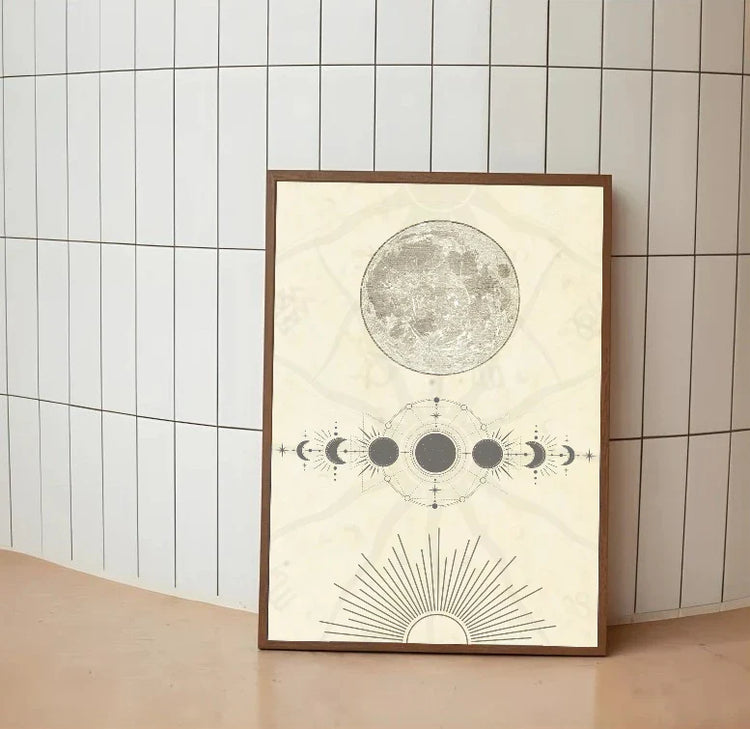
1. Anchor Dark Prints on Neutral or Charcoal Backdrops
Because constellation posters feature deep dark backgrounds, they create immediate visual contrast. - On light walls (warm ivory, linen white, or soft beige common in Indian apartments), a single A3 dark celestial chart acts as a commanding focal point. - On dark accent walls (deep navy, slate grey, or forest green), the poster integrates quietly, letting the fine white lines and brass-toned coordinate rings emerge subtly under warm evening lamps.
For a deeper look at moody, intellectual interior palettes, explore our companion styling guide on dark celestial room decor and moody wall art.
2. Calibrate Lighting to 2700K–3000K Warm Ambient Hues
Harsh 6500K daylight white LED bulbs make dark celestial prints look cold, clinical, and washed out.
Instead, illuminate your star chart using warm white light between 2700K and 3000K. A gooseneck desk lamp angled at 45 degrees, a warm bedside sconce, or a discreet floor uplighter brings out the rich depth of dark navy and black cardstock without casting direct specular reflections on the paper.
3. Build a Cohesive Three-Piece Celestial Triptych
Rather than scattering multiple unrelated space posters across different walls, group them into an intentional horizontal or vertical arrangement:
- Centerpiece: A circular A3 constellation planisphere map (e.g., True North or Silent Cartography).
- Left Flank: A vertical lunar phase sequence or planetary diagram showing geometric orbital rings.
- Right Flank: A deep-sky photographic print or monochrome typography piece (e.g., Event Horizon or Andromeda).
This three-piece setup creates an intellectual narrative on your wall: movement, geometry, and observational astronomy working together harmoniously. You can also explore pre-coordinated multi-print layouts across our wall collage kits for effortless room makeovers.
4. Mounting: Frame Choices vs. Renter-Safe Installation
Depending on your living situation, choose the mounting method that protects both your wall paint and the print:
- Wood or Metal Framing: A slim 15–20mm natural oak, dark walnut, or matte black frame gives vintage astronomical charts an elegant, museum-grade finish. For glazing, opt for anti-reflective glass or acrylic to minimize reflections.
- Renter-Safe Peel & Stick: If you live in a rented flat, PG, or hostel in cities like Bangalore, Mumbai, or Pune where drilling is strictly prohibited, frameless mounting is ideal. Art Theory posters come ready with pre-applied, wall-safe adhesive strips. Test one small corner first on your wall finish, press firmly along all four edges, and enjoy a clean, modern aesthetic without risking your security deposit.
Frequently Asked Questions
Can you use a constellation wall poster for actual stargazing outside?
Yes, a hemispheric constellation poster oriented to your latitude provides a solid guide for locating major constellations like Orion, Taurus, and Ursa Major. However, static posters reflect the sky at a specific date and time, whereas dynamic rotating planispheres or astronomy apps adjust for exact observation hours.
Which constellation poster orientation is best for viewing from India?
Because mainland India lies between 8°N and 32°N latitude, a Northern Celestial Hemisphere star chart is most accurate for identifying stars in the Indian night sky. It clearly shows northern constellations like Ursa Major (Saptarishi), Cassiopeia (Sharmistha), and Orion (Mriga) directly overhead throughout winter and spring.
What is the best poster size for reading fine star chart details?
A3 size (29.7 × 42.0 cm) is the sweet spot for reading celestial star charts. Smaller formats like A6 or standard postcards condense fine coordinate numbers and magnitude dots below legible thresholds, while A3 provides crisp legibility from a comfortable desk or bedside viewing distance.
How do you stop dark space posters from showing glare in bright rooms?
Choose posters printed on heavy matte cardstock (such as 350 GSM matte paper) rather than glossy photo paper to eliminate surface glare. If framing, position the artwork away from direct opposite windows and use warm 2700K ambient side lighting instead of direct overhead bulbs.
Bring the Night Sky to Your Walls
Reading a constellation poster transforms a piece of wall decor into an engaging window to the wider universe. When you understand the right ascension grid, recognize why dot sizes vary with stellar brightness, and appreciate the history behind the 88 formal celestial borders, the artwork gains lasting depth that outlives temporary decor trends.
If you are ready to design your own celestial wall, start with a measured wall space, choose high-grammage matte prints that preserve fine linework, and balance dark astronomical inks with warm, inviting lighting.
Explore the collection: Discover curated star maps, lunar diagrams, and deep space prints in Art Theory’s Through The Telescope collection.
Read next: Learn how to balance space art across living rooms, bedrooms, and desks in our complete cosmic wall art styling guide.